
IDENTIMATCH® · WORKLIST AUTOMATION
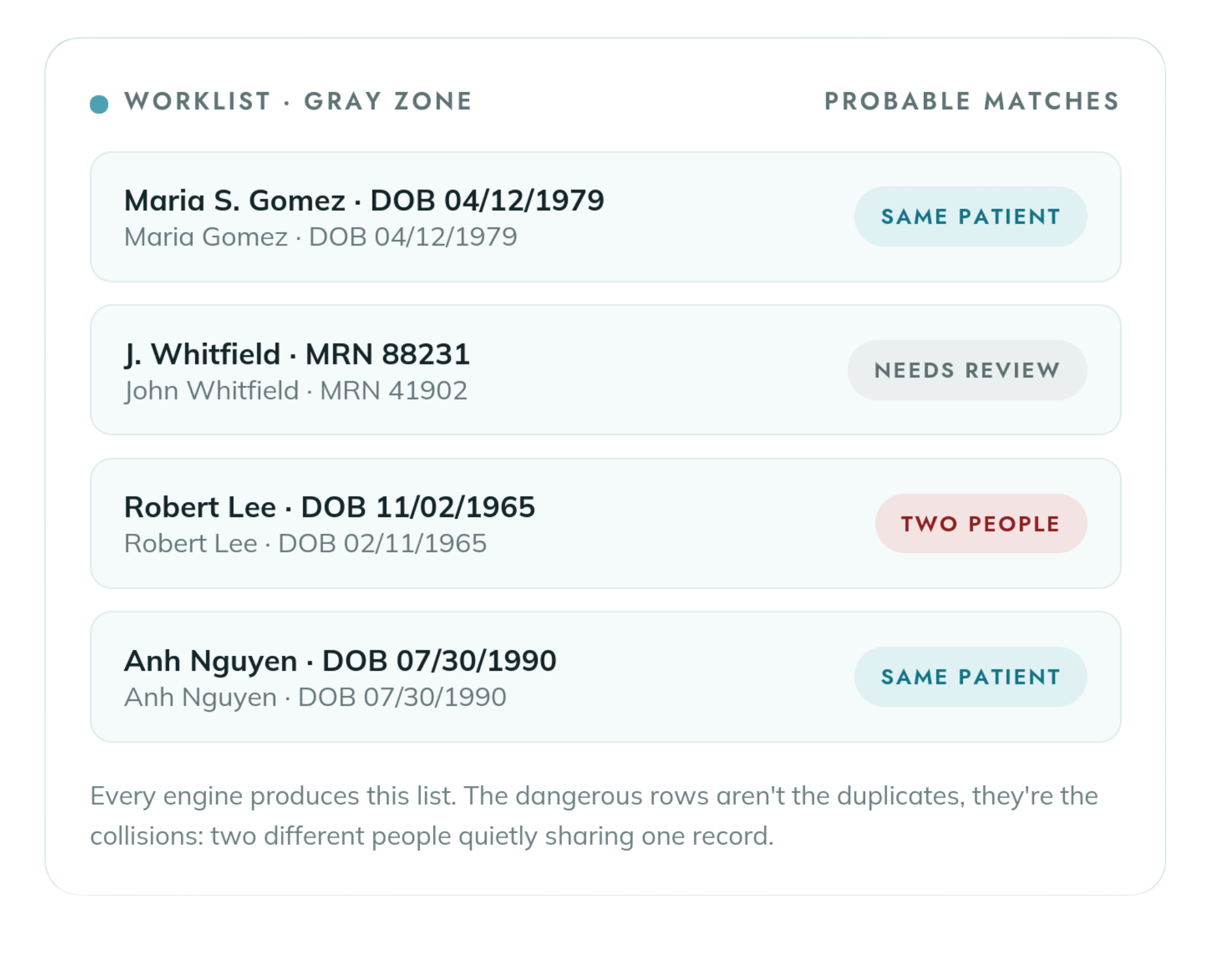
When two patients collide into a single chart, the wrong history can reach the wrong person. IdentiMatch® automatically resolves up to 90% of the your EHR leaves behind, so your team handles only the true exceptions.
THE STAKES
While probable matches sit in a queue waiting for manual review, clinicians make decisions on records that may be incomplete, fragmented, or belong to the wrong person entirely. That delay between “probable match” and “resolved record” is where harm happens.
Robert Lee
DOB 11/02/1965
Penicillin allergy
Anticoagulant therapy
OVERLAY
Robert Lee
DOB 02/11/1965
No known allergies
Pre-op clearance
of providers report witnessing a medical error traced to patient misidentification.
Ponemon Institute
preventable deaths a year are linked to duplicate and mismatched records.
CRICO Strategies
An overlay is the most dangerous record in a health system: two different patients collapsed into one chart. One person’s allergies, medications, and history get attributed to another, and no one knows it happened.
Every week a record stays in the gray zone is a week a patient carries the risk of a mismatched or collided chart. Speed of resolution is a safety metric, not just an operational one.
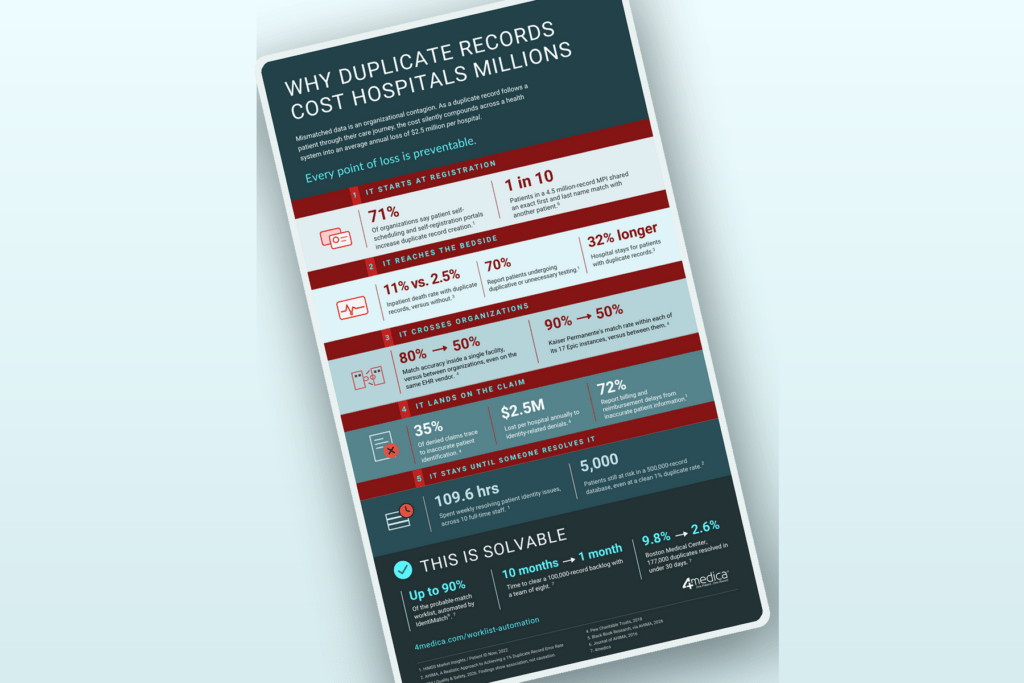
INFOGRAPHIC · THE COST OF DUPLICATES
Mismatched data is an organizational contagion. As a duplicate record follows a patient through their care journey, the cost silently compounds across a health system into an average annual loss of $2.5 million per hospital.
MEET IDENTIMATCH®
IdentiMatch® ingests the worklist from any MPI or EHR matching engine, applies your match rules once, and carries those decisions across every similar case. Your team is left with a true exception list, not a backlog. To clear a 100,000-record backlog, a team of eight typically needs 10 months by hand. With IdentiMatch®, the same team finishes in about one month.
Pulls worklists from any MPI or EHR matching engine.
Groups record pairs by your match criteria.
Your rules decide; the decision carries across all similar cases.
Shrinks the worklist dramatically, hands back only true exceptions.
Checks for consistency to strengthen stewardship and compliance.
Works with 4medica’s matching engine, another vendor’s, or both · Software or full-service delivery · Deploys in weeks, not months
ROI CALCULATOR
Different database, different team, different gray zone. Move the sliders to see how long manual identity review would take you, and what IdentiMatch® would save.
The size of your master patient index.
Probable matches your EHR can't auto-resolve. Often higher after a merger.
People available to review matches by hand.
A realistic manual pace for careful identity review.
Salary; many orgs load this ~1.3× for benefits and overhead. Adjust to taste.
Your Gray Zone backlog
100,000 patient identities to resolve before records can be safely merged.
9.9 mo
8 stewards full-time
1.0 mo
90% auto-resolved
Labor cost by hand
$396,000
Labor cost with IdentiMatch®
$40,000
Labor cost saved
$357,000
Labor alone, before the downstream cost of denied claims, duplicate testing, and patient-safety exposure.
At this pace, manual identity review takes about 9.9 months. IdentiMatch resolves roughly 90% automatically, leaving your team about 1.0 months of genuine exceptions, the cases that actually need human judgment.
Directional estimates based on your inputs and 4medica IdentiMatch® deployment data.
Let’s look at where your duplicates are actually hiding. Schedule a 30-minute Duplicate Reduction Strategy Session – a practical working session, not a sales demo.
CASE STUDY · BOSTON MEDICAL CENTER

When Boston Medical Center doubled its patient population through a merger, Epic required a patient mismatch rate below 3% before go-live. BMC was sitting at 9.8%, roughly 1 in 10 patient identities in question, with a hard deadline and penalties on the line. They approached it in two parts.
1 · Identity verification
Deciding, across thousands of probable matches, which records were truly the same patient and which only looked alike.
2 · Clinical remediation
Once identity was settled, safely merging the records so each patient’s clinical history was whole again.
IdentiMatch® automated identity verification across the probable-match queue, followed by clean clinical remediation through BMC’s HL7 interface. Identity duplication was safely resolved down to 2.6%, with 177,000 records made whole, ahead of schedule.
“4medica’s IdentiMatch® didn’t just give us a report… seeing our mismatch rate drop from nearly 10% to 2.6% in less than a month was incredible. It protected our timeline and, most importantly, it protected our patients.”
Boston Medical Center
duplicate rate
records resolved
days
INDUSTRY BENCHMARKING REPORT
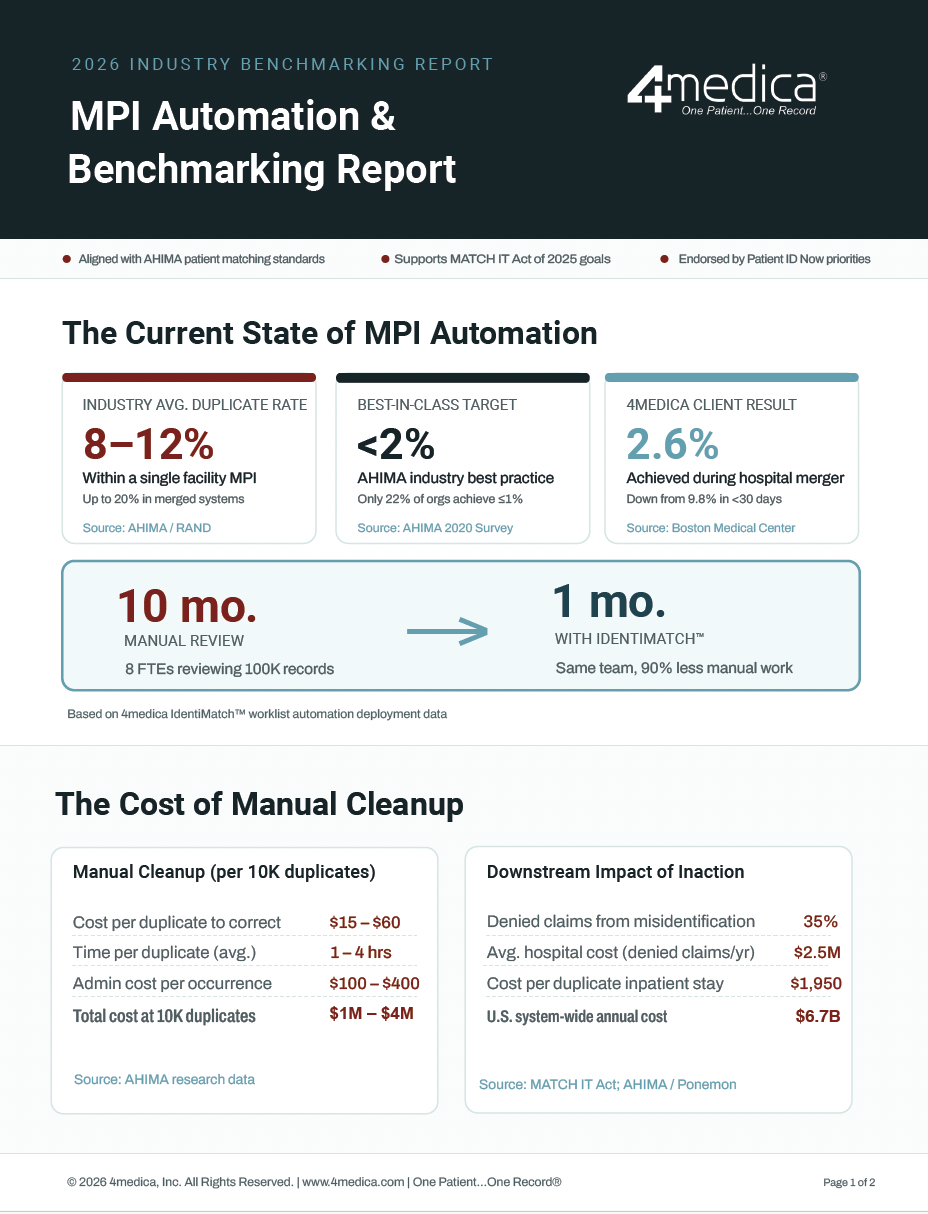
Most teams self-report a duplicate rate of 2 to 3%. The reality across the industry is 8 to 12%, because near-duplicates hide in the gray zone where standard reporting can’t see them. Our MPI Automation & Benchmarking Report lays out the numbers, and how you compare to AHIMA’s recommended target.
industry duplicate rate
to correct each duplicate
of denied claims tied to bad ID
U.S. system-wide, per year
best-in-class target
don’t know their own rate
Sources: AHIMA / RAND, AHIMA research data, MATCH IT Act, Ponemon Institute, AHIMA 2020 Patient ID Survey.
OUR COMMITMENT TO STANDARDS
Accurate patient identity is becoming a national data-standards question, and the organizations getting ahead of it now will set the bar instead of scrambling to meet it. For nearly three decades, 4medica has worked to make accurate patient matching the standard across healthcare, alongside the people writing the rules.
The 2026 standard for the demographic data elements behind reliable patient matching. IdentiMatch® is built to align with it.
Endorsed by AHIMA, HIMSS, and CHIME, it would set a national standard for measuring patient match rates. We build to that future today.
We stand with the coalition for a nationwide patient-matching strategy, because “One Patient, One Record” is the work, not a tagline.
WHERE IT FITS
Merge populations quickly without sacrificing accuracy.
Ensure clean, consistent data before go-live.
Keep records clean and compliant over time.
Maintain longitudinal views and avoid false matches.
Works with or without 4medica’s engine · Software or full-service · Business-rule–driven automation · Optional stewardship and auditing
READY WHEN YOU ARE
A 30-minute working session on your gray zone: where your duplicate rate really sits, what it’s costing you, and the fastest path to near-perfect. No pitch, no commitment, yours to keep.
All of 4medica's identity management solutions are completely modular, offered standalone or bundled, increasing the value and useability of your data from good to better to best.
To clear a 100,000-record backlog, a typical team of eight data stewards needs 10 months of manual review. With automation, that same team can finish the job in just one month. See the math behind the backlog.
While records sit in the "Gray Zone" waiting for manual review, clinicians are making decisions based on fragmented patient data. Discover why the delay between "probable match" and "merged record" is a critical patient safety risk.
Deterministic matching engines are great at the "first pass," but they dump the hardest 10-20% of work onto your staff. Learn why the "probable match" gap exists and how to close it without hiring a single new employee.
| Cookie | Duration | Description |
|---|---|---|
| cookielawinfo-checkbox-analytics | 11 months | This cookie is set by GDPR Cookie Consent plugin. The cookie is used to store the user consent for the cookies in the category "Analytics". |
| cookielawinfo-checkbox-functional | 11 months | The cookie is set by GDPR cookie consent to record the user consent for the cookies in the category "Functional". |
| cookielawinfo-checkbox-necessary | 11 months | This cookie is set by GDPR Cookie Consent plugin. The cookies is used to store the user consent for the cookies in the category "Necessary". |
| cookielawinfo-checkbox-others | 11 months | This cookie is set by GDPR Cookie Consent plugin. The cookie is used to store the user consent for the cookies in the category "Other. |
| cookielawinfo-checkbox-performance | 11 months | This cookie is set by GDPR Cookie Consent plugin. The cookie is used to store the user consent for the cookies in the category "Performance". |
| viewed_cookie_policy | 11 months | The cookie is set by the GDPR Cookie Consent plugin and is used to store whether or not user has consented to the use of cookies. It does not store any personal data. |