How Data Quality Impacts Revenue More Than You Think
Every health system tracks its denial rate. Far fewer can tell you where those denials actually begin. That gap, between where a data error is created and where its cost finally shows up, is the reason patient identity quietly drains revenue year after year while everyone is looking in the wrong place for the leak.
The error is cheap to make and impossible to see
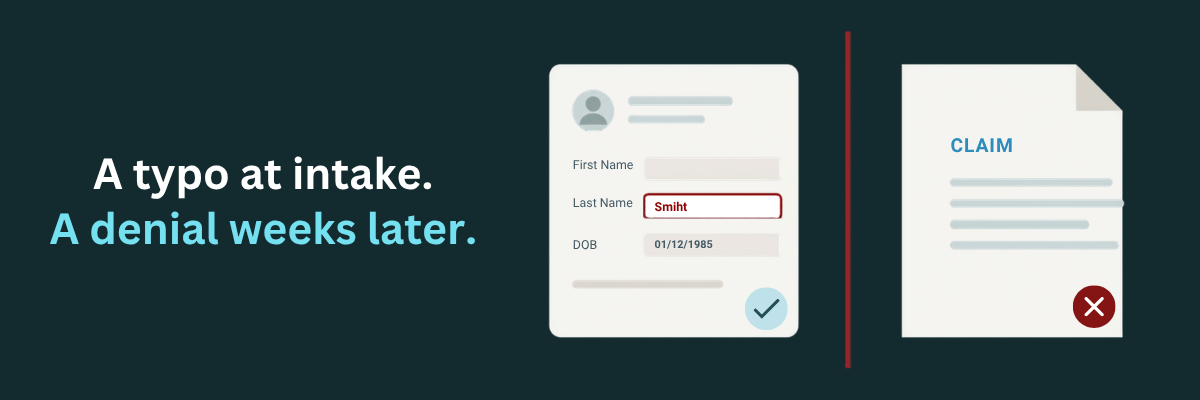
Most revenue leakage starts at a moment that costs nothing to get wrong. A patient checks in under a married name instead of the maiden name already on file. A registrar transposes two digits in a birthdate. An order goes in against a record that looks right but belongs to a slightly different version of the same person. None of it triggers an alarm. The visit proceeds, care is delivered, and the encounter closes as if everything matched.
At intake and order entry, a mismatched record is indistinguishable from a clean one. There is no red flag, no rejected screen, nothing lands on the books. The problem is fully formed and completely invisible at the exact moment it would be cheapest to fix.
The cost shows up somewhere else entirely
Weeks or months later, the claim goes out, and the invisible error becomes a very visible number. The payer kicks it back. Now a biller who never met the patient and had nothing to do with registration is working a denial, hunting for the discrepancy, and resubmitting it if there’s time.
This is not a rare occurrence. According to a 2026 AHIMA analysis citing Black Book Research, roughly 35 percent of denied claims trace back to inaccurate patient identification, costing the average hospital about $2.5 million a year and the US health system more than $6.7 billion. And the pressure is rising, not easing. Initial denial rates have climbed into the low double digits in recent years, so the same identity errors now hit a system that is already denying more of everything.
The people absorbing that cost sit in the revenue cycle. The people who created it sat at different points of patient intake, often registration or an emergency room visit. The two are separated by weeks or months of calendar time and an entire org chart, which is exactly why the connection is so rarely made.
The leak is permanent, not just delayed
It would be one thing if every denied claim eventually got reworked and paid. It doesn’t. Reworking a single denied claim runs somewhere in the range of $25 to $181 depending on claim type, and by most industry estimates a majority of denied claims, between 60 and 65 percent, are never resubmitted at all.
That reframes the whole problem. Identity errors do not merely delay revenue. They permanently lose a share of it. Every denial that never gets reworked is money the organization earned, delivered care for, and then simply never collected, because the trail back to a registration typo was too cold and too costly to chase.
And denials are only the part that surfaces. The same broken identity produces duplicate and unnecessary testing when a prior result can’t be found on the right record. In a HIMSS survey conducted for Patient ID Now, 70 percent of organizations reported patients undergoing duplicative or unnecessary services, and 72 percent reported delays in billing and reimbursement tied to inaccurate patient information. That is added cost on the care side and lost revenue on the billing side, both traceable to the same root.
Why the gap is the real problem
The distance between cause and cost is not a detail. It is the reason the problem persists.
When an error is invisible where it’s created and only visible where it’s paid for, no single team owns it. Registration is measured on throughput, not match quality. Revenue cycle is measured on denials, but can’t reach back to fix what caused them. The error falls into the seam between departments, and seams are where problems live forever.
Closing that seam means moving the fix upstream, to where the error is actually made, and keeping it closed as new records arrive. Resolving identity at the point of ingestion, enriching incomplete records so variations of the same patient match instead of multiplying, and governing that flow continuously is what stops the leak at the source rather than mopping it up downstream.
What closing the gap looks like
The results are measurable when identity is treated as an operating standard rather than a periodic cleanup. Working with Boston Medical Center, a 539-bed Level 1 trauma center in the middle of a merger, our team resolved roughly 177,000 probable duplicates and brought the duplicate rate from 9.8 percent to 2.6 percent in under 30 days.
The revenue impact of a change like that doesn’t show up as a line item labeled “identity.” It shows up as fewer denials to work, fewer claims abandoned, fewer repeated tests, and fewer hours spent chasing discrepancies that a clean record would never have produced. That same HIMSS survey found organizations spending an average of 109.6 hours per week on patient identity issues, with around 10 full-time employees dedicated to the work. Give those hours back, and you’ve recovered capacity as well as revenue.
Data quality isn’t a back-office concern. It’s a revenue strategy that happens to start at the front desk.
See where your own leak begins
The hardest part of this problem is that you can’t manage what you can’t see, and identity errors are designed to stay invisible until they’ve already cost you. A 30-minute Duplicate Reduction Strategy Session is a practical working session, not a sales demo: where your duplicate rate really sits, what it’s costing you downstream in denials and rework, and the fastest path to near-perfect. One patient. One record. Right from the first point of entry, and kept that way.
Book a Duplicate Reduction Strategy Session.
A 30-minute working session will help you identify where your duplicate rate really sits, what it’s costing you, and the fastest path to near-perfect.