Why Clean Data Matters More Than Connected Data
For years, the goal in healthcare data was simply to get systems talking to each other. Connect the hospital to the labs, the labs to the specialists, the specialists to the health information exchange. Connection was the hard part, and the assumption was that once the pipes were in place, the value would follow.
The pipes are largely in place now. And a lot of organizations are discovering an uncomfortable truth: connection was the easy half.
You can connect everything and still not be able to trust what comes through. Because moving data and improving data are two entirely different jobs, and only one of them was ever solved by laying pipe.
Connection solved the easy half
Clean data is not a vaguer, nicer word for connected data. It refers to specific work that happens to the data itself, ideally at the moment it enters the system rather than after it has spread everywhere.
A patient record is clean when four things are true about it:
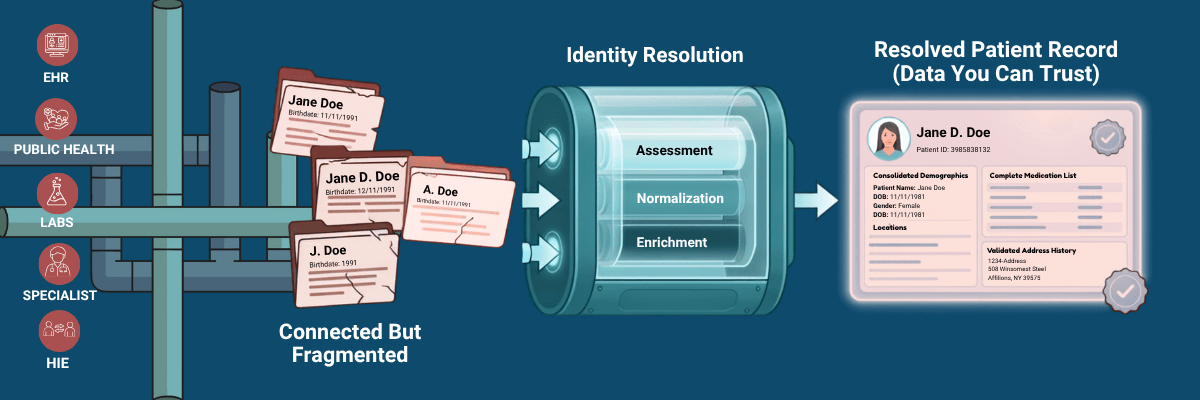
It is resolved. The system knows whose record it is. One person maps to one record, not to three confident-looking versions of a person.
It is normalized. The same field looks the same no matter which system it came from. Names, dates, codes, and formats are reconciled to a consistent standard, so a record from one source can actually be compared with a record from another instead of sitting beside it as a near-duplicate.
It is complete. The demographic and contact details needed to reach the patient, report on the patient, and coordinate their care are present and current, not left over from a move three years ago.
It is measurable. Someone can say, with evidence, how good the data is today and whether it is getting better or worse.
Most organizations treat this as a single project. It is not. It is a sequence, and each stage answers a question the previous one could not.
Why the stakes are higher here
In banking, an identity error costs money and time. Painful, recoverable.
In healthcare, an identity error can cost a life. A record that is missing because it is trapped under a different version of the patient’s name means a clinician makes a decision without the full picture. A record that has been overlaid with someone else’s data means a clinician is looking at the wrong allergies, the wrong medications, the wrong history entirely. One mismatch, one wrong merge, and the safest assumption a care team can make, that the chart in front of them is complete and correct, no longer holds.
This is what separates patient identity from an ordinary IT cleanup task. It is not housekeeping. It is the precondition for safe care.
The “connected but unusable” trap
Picture a clinician looking at a patient record assembled from six connected sources. On paper, this is the dream: a complete, cross-organizational view. In practice, it can be a mess.
One source spells the name one way, another abbreviates it. Birthdates disagree. The same lab result appears three times in slightly different formats. A medication list from one system contradicts the list from another, and there is no way to tell which is current. The record is technically complete but functionally untrustworthy. Everything was delivered, and nothing can be relied on.
This is the trap of “connected but unusable.” The data moved, so the project looks successful. But the person who has to make a decision from it is no better off, and arguably worse off, because now they have more conflicting information to reconcile in less time. Volume went up. Trust did not.
What “clean” actually means
Clean data is not a vaguer, nicer word for connected data. It refers to specific work that happens to the data itself, ideally at the moment it enters the system rather than after it has spread everywhere.
A patient record is clean when four things are true about it:
It is resolved. The system knows whose record it is. One person maps to one record, not to three confident-looking versions of a person.
It is normalized. The same field looks the same no matter which system it came from. Names, dates, codes, and formats are reconciled to a consistent standard, so a record from one source can actually be compared with a record from another instead of sitting beside it as a near-duplicate.
It is complete. The demographic and contact details needed to reach the patient, report on the patient, and coordinate their care are present and current, not left over from a move three years ago.
It is measurable. Someone can say, with evidence, how good the data is today and whether it is getting better or worse.
Most organizations treat this as a single project. It is not. It is a sequence, and each stage answers a question the previous one could not.
The six layers of patient identity data quality
Healthcare identity management progresses through six layers, moving from good to better to best. Each one builds on the layer before it, and each one is available on its own.
Layer | What it answers | Maturity |
Master Patient Index (MPI) | Which records belong to the same person? | Good |
Identity Assessment and Clean-Up | How bad is the problem, really? | Good |
Referential Identity Matching | What is our internal data unable to see? | Better |
Identity Enrichment | Is the record complete enough to act on? | Better |
Identity Intelligence | Is this getting better or worse, and can we prove it? | Better |
Worklist Automation | Who resolves the records the engine could not decide? | Best |
1. Master Patient Index (MPI)
A Master Patient Index is the foundational layer of identity management: a single index that links a patient’s records across systems so that one person resolves to one record. This is where nearly every organization starts, and for many it has been the entire data quality program for years.
An MPI handles the clear-cut matches well. What it cannot do on its own is tell you how much it is missing.
2. Identity Assessment and Clean-Up
An identity assessment measures your real duplication rate rather than your reported one, then delivers a prioritized roadmap for remediation. The gap between the two numbers is usually the surprise.
Organizations commonly self-report duplication in the 2 to 3 percent range. In 4medica’s assessments, the actual figure typically lands between 8 and 12 percent. The difference comes from outdated or incomplete reporting, near-duplicates sitting in the Gray Zone where matching logic is uncertain, and a general sense that the data is fine because nothing has visibly broken yet. You cannot fix what you cannot see, and you cannot prioritize what you have not measured.
3. Referential Identity Matching
Referential identity matching validates your internal records against external sources that are continuously refreshed, including historical addresses, name changes, phone numbers, and email.
It exists because internal data has blind spots that internal data cannot detect. Patients move, marry, change names, and hand over incomplete demographics at registration. An engine that only compares your records to your other records will never find what none of your records contain. Referential matching closes that gap by bringing in what you never had.
4. Identity Enrichment
Identity enrichment fills the gaps in records that are already correctly matched, adding verified demographic, geographic, and historical detail from trusted third-party sources.
A record can be attributed to exactly the right person and still be too thin to use. If the phone number is disconnected and the address is two moves old, outreach does not land, quality reporting comes back incomplete, and population health models are built on holes. Resolution makes a record correct. Enrichment makes it usable.
5. Identity Intelligence
Identity intelligence is the visibility layer: dashboards that show duplication trends over time, where new duplicates are entering the system, how individual source systems are performing, and what the data quality program is returning.
Without it, identity management is something you fund and hope about. With it, it becomes something you can manage, staff, and defend in a budget conversation. It also shifts the work from reactive to preventive, because the point of knowing where duplicates originate is to stop creating them.
6. Worklist Automation
Worklist automation resolves the records that matching engines cannot decide on their own.
Every patient matching engine, 4medica’s or another vendor’s, produces a work list of probable matches that land in the Gray Zone and require human review. That review is slow, inconsistent from reviewer to reviewer, and expensive. It also becomes a critical path item during hospital mergers, EHR migrations, and large-scale clean-ups, when the deadline is fixed and the backlog is not.
IdentiMatch® ingests the work list from any MPI or EHR matching engine, groups record pairs by match criteria, and applies your business rules once so that a single decision carries across every similar case. Manual patient matching drops by up to 90%, leaving data stewards with a true exception list rather than a queue. During a major hospital merger, Boston Medical Center used it to cut an Epic-generated work list from 9.8% to 2.6% in under one month, eliminating 177,000 duplicates.
This is the layer where clean data stops depending on how many people you can hire.
You do not have to do all six at once
The layers are modular. They can be adopted standalone or bundled, and an organization running MPI alone is doing real, necessary work.
But the value compounds in sequence. Assessment reveals what the MPI is missing. Referential matching closes what internal data cannot see. Enrichment makes the resolved record usable. Intelligence makes the whole program measurable. Automation removes the manual bottleneck that constrains all of it. Good, better, best.
The question is not whether to do everything. It is knowing which layer you are on, and what the next one would change.
Pipes move water. They do not purify it.
A useful way to hold the distinction: connectivity is plumbing. Plumbing is essential, and a building without it does not function. But no one confuses having pipes with having clean water. The pipe delivers whatever you put into it. If the water going in is contaminated, better plumbing just distributes the contamination more efficiently to every tap.
Healthcare spent a long time, appropriately, building the plumbing. The next phase of value is not more pipe. It is what flows through it. The organizations that pull ahead will be the ones that treat the water, not just the ones that finished the plumbing, because a connected system full of untrustworthy data is not an asset. It is a liability that scales.
Reframing the question
The question to ask of any data initiative is shifting. For a decade it was “is it connected.” That question has largely been answered, and answering it turned out to be table stakes, not a finish line.
The question now is “can I trust what is flowing between the connections.” Is it resolved to the right person, normalized, complete, and measurable, or is it simply arriving in greater volume and greater confusion. Everyone can connect systems. Far fewer are improving the data moving between them, and that gap is exactly where real interoperability separates from the appearance of it.
Connection was never the point. It was the precondition. The point was always to put trustworthy information in front of the people making decisions about a patient. A pipe cannot do that. Clean data can.
Book an Identity Resolution Strategy Session.
A 30-minute working session will help you identify where your duplicate rate really sits, what it’s costing you, and the fastest path to near-perfect.