What is the purpose of a master patient index?
The purpose of a master patient index (MPI) is to give every patient one accurate, consistent identity across a healthcare organization’s systems and facilities. By assigning each patient a unique identifier and linking their demographic and clinical information, an MPI helps providers find the right record, reduce duplicates and coordinate care.
Key points
- An MPI assigns each patient a unique identifier, such as an MRN or UPI.
- It brings data from EHRs, laboratory, radiology and other systems into one view.
- It protects data integrity through cleansing, duplicate detection and regular audits.
- It lets authorized users find records quickly by name, date of birth or identifier.
- An effective MPI also needs interoperability, security, scalability and support for data sharing.
What are the key functions of a master patient index?
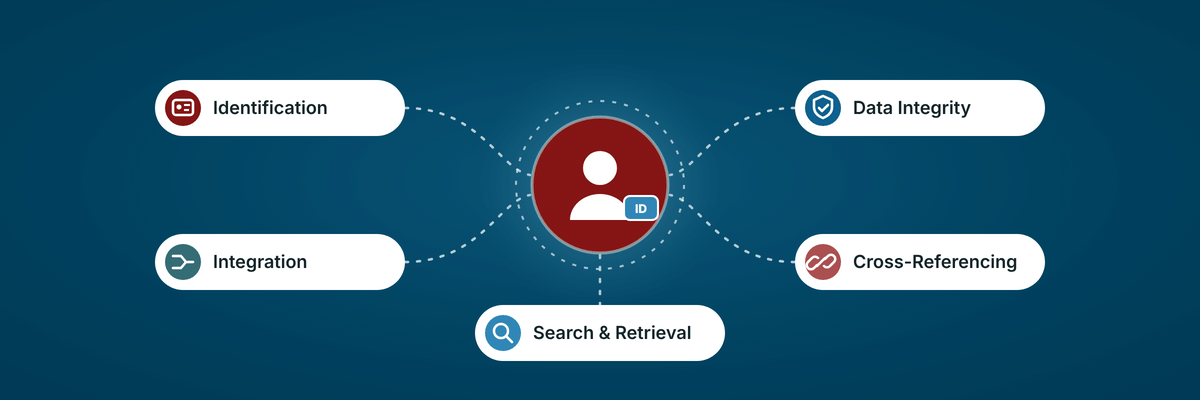
A master patient index performs five key functions that keep patient information organized, accurate and easy to find.
| Function | What it does | Why it matters |
|---|---|---|
| Patient identification | Assigns each patient a unique identifier tied to their demographic and clinical data | Records can be retrieved and linked efficiently |
| Data integration | Consolidates data from EHRs, laboratory, radiology and other healthcare applications | Clinicians see a complete picture of a patient’s health |
| Data integrity | Uses data cleansing, duplicate record detection, audits and validation | Reduces duplicates, errors and inconsistencies |
| Cross-referencing | Links records from different sources to the correct person | Providers see up-to-date information wherever it originated |
| Search and retrieval | Uses indexing and search to find records by name, date of birth or identifier | Authorized users get patient information quickly |
To learn how an MPI matches and links records behind the scenes, read What is a master patient index?
Why does a unique patient identifier matter?
A unique patient identifier keeps each person’s records connected, so information from every source lands on the right patient. Each patient receives a distinct identifier, such as a medical record number (MRN) or unique patient identifier (UPI), that stays consistent across all systems and facilities in the organization. Accurate identification helps prevent errors, improve care coordination and enhance patient safety.
What makes a master patient index effective?
An effective MPI combines accurate patient identification with interoperability, strong data quality, security, scalability and support for data sharing.
| Requirement | What it involves |
|---|---|
| Unique patient identification | A distinct identifier for each patient, consistent across all systems and facilities |
| Data integration and interoperability | Works with data from any vendor or technology, using standards such as HL7 and FHIR |
| Data quality and integrity | Regular cleansing, duplicate detection and validation, backed by data governance and stewardship |
| Privacy and security | Access controls, encryption and audit trails that protect sensitive patient data |
| Scalability and performance | Handles growing data volumes and large data sets with real-time access |
| Continuity and data sharing | Shares complete, up-to-date records across hospitals, clinics and specialty centers |
Interoperability standards help organizations break down data silos and create a unified view of each patient. Learn more about healthcare interoperability.
How does an MPI keep patient data secure?
An MPI keeps patient data secure by limiting who can see it, protecting it in transit and at rest, and tracking every access.
- Access controls: restrict patient data to authorized personnel only.
- Encryption: protects data during transmission and storage.
- Audit trails: track who accessed data and support compliance with HIPAA.
These measures protect against unauthorized access, reduce the risk of data breaches and build trust among patients and providers.
How does an MPI support continuity of care?
An MPI supports continuity of care by making complete, up-to-date patient records available across hospitals, clinics and specialty centers. This matters most during care transitions and when patients see multiple providers. When every care team works from the same accurate record, coordination improves and the risk of medical errors drops. A scalable, high-performance MPI keeps that information available in real time, even as data volumes grow.
How can 4medica help?
4medica’s MPI solutions support accurate patient identification, data integration, data integrity and secure data management, helping organizations improve care coordination and reduce medical errors. 4medica’s MPI-as-a-Service works with 4medica’s MPI or an organization’s existing MPI, is designed to stop duplicates before they enter the system, and runs in the cloud without added infrastructure. Learn more about 4medica’s MPI solution, or start with a health data quality assessment.
Frequently asked questions
What is a unique patient identifier?
A unique patient identifier is a distinct number, such as a medical record number (MRN) or unique patient identifier (UPI), assigned to one patient and used consistently across systems.
Does a master patient index store clinical information?
Yes. Along with unique identifiers and demographic information, an MPI holds essential clinical information and links each patient’s records across systems.
Which organizations need a master patient index?
Hospitals and health systems; HIEs, CIEs and HDUs; RCM companies; and ACOs all depend on an MPI to keep patient identities accurate across the systems and organizations they connect.
What interoperability standards does an MPI use?
Common standards include Health Level Seven (HL7) and Fast Healthcare Interoperability Resources (FHIR), which let an MPI exchange data with systems from different vendors.